| Chilika Resource Management Information
Coastal resources in most places, including Chilika Lake, are often managed by multiple agencies like; government, private and community organizations. This management is also carried out at different political scales (e.g., local, municipal, state, national or international scales) and over different economic sectors (e.g., fisheries, tourism, urban development). But there is often lack of co-ordination between these management organizations and local populations. For example, fisheries departments usually deals with regulations only pertaining to the access to and use of fish stocks, and pay little or less attention to the fishing area (environmental aspect) and fisher folk’s livelihoods. This lack of co-ordination can result in conflicts among user groups (fisher folk, non-fisher folk and government officials) and ultimately results in resource exploitation and environmental degradation.
| Management Policy Impact on the Livelihood
Fresh fish trading first began in Chilika in 1930, when the market was established in Kalupada Ghata, which is now the biggest fish exporting centre in Chilika. Other exporting centres now exist at Rambha, Khallikote, Balugaon, Kuhari and Bhusandpur, which are important points for the export of Chilika fish to places like Calcutta, Kharagpur, Tata Nagar, Rourkela and Cochin. Fish trading has historically been mainly carried out by carrier agents who purchase fish from the fishermen. The fish are taken to assembly grounds and sold to exporting merchants, who aggregate fish from various centers and try to get better prices by sending it on ice to distant locations.
To resolve several management related issues and regulate the fishing trade in the area, the Central Fishermen Co-operative Marketing Society, Ltd. (CFCMS) was formed in 1959. In the Chilika Reorganization Scheme of 1959, the open auction of fisheries leases was suspended and all the fishery sources were leased out to the Central Fishermen Co-operative Marketing Societies (CFCMS); this apex body was used to sub-lease fishery resources except Dian to the Primary Fishery Co-operative Societies (PFCS). Legally, all fish caught by PFCS members must be marketed through the CFCMS. Although this condition is laid down in sub-leases to PFCS members, it was not strictly enforced, and as a result, most of the PFCS members market their fish independently. The CFCMS only markets the catches of willing societies, which allows societies that market independently to undercut CFCMS prices. Thus, benefits from price increases flow to middlemen, rather than to traditional fishermen. The only way for traditional fishermen to improve their economic situation is to increase their catch from the lake or to illegally sublease their fisheries leases to third parties, resulting in the over-extraction of fishery resources and conflict over the lake’s use.
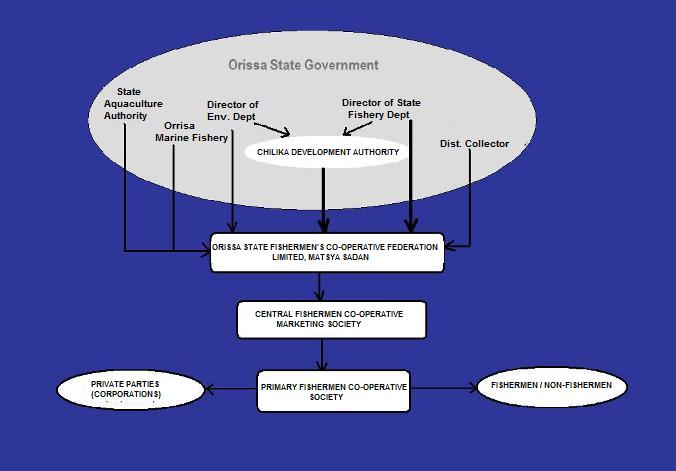
Currently, there are several institutions or departments that play an important role in the fisheries resource management in Orissa (Fig). All of these departments deal with different aspects of fisheries, but their aim is the same, i.e. resource management. The Chilika Development Authority (CDA) is a coordinating body for all stakeholder groups in the lake basin. It works closely with the state government to conserve and restore the Chilika Lagoon ecosystem. All these governing bodies control the Orissa State Fishermen’s Cooperative Federation (Matsya Sadan), which directly controls the Central Fishermen Cooperative Marketing Society (CFCMS). As per the lease policy, the leases are granted to the Primary Fishermen Cooperative Society (PFCS) through this CFCMS and through them to private parties, traditional fishermen or new fishermen. This institutional structure also controls Chilika Fish Marketing, which has direct connections with local traditional fishermen as well as the traders and new fishermen.
Although traditional prawn and fish capture methods are still used in the lake, aquaculture has been adopted by both the traditional fishermen and new fishermen in recent years, with serious implications for the survival of traditional fisheries as well as the sustainability of the resource base. Both the management policies and rules enforced by the state government in the fishery resource management sector have implications for resource sustainability.Anthropogenic activities such as aquaculture and the use of zero nets have exerted pressure on fish fauna in Chilika by eliminating immature fish and prawns from the system, thus affecting the sustainable fish production of the lake. Fishermen cooperative societies have failed to provide economic protections to poor fishermen. All this implies that the fragile equilibrium between the ecology and economy of locals is under threat. The capture fisheries process in the lake has started giving way to culture fisheries, which compromise environmental quality for the better economic profit. Thus, it is essential to regulate the extensive aquaculture and prioritize the rights of capture fisheries.
|